
Archive

April 2026

Browsing

The grandson of the inventor of the Reese’s Peanut Butter Cups, who has publicly criticized The Hershey Company for tinkering with the classic formula in its spinoff products, appears to have gotten some sweet revenge.

The candy company has announced that it will return to using “classic milk and dark chocolate recipes” in all its Reese’s and Hershey’s products by 2027.

“If this is true, the people who deserve the credit are the loyal fans who were alarmed by what Hershey was doing,” Brad Reese told NBC News on Wednesday. “But I am seeing a lot of red flags here. I think what Hershey is trying to do here is change with PR narrative.”

Reese, whose demands that Hershey stop skimping on chocolate went viral in February, said he trusts his taste buds more than he trusts the company that produces iconic candies that bear his family name.

“If something like the Valentine’s Day Reese’s Mini Heart still doesn’t taste like real milk chocolate next year, I’ll know they’re lying,” he said.

Hershey CEO Kirk Tanner made the announcement on Tuesday in an interview with Bloomberg.

“We’re going to make some small investments to really align the portfolio to what the brand stands for,” Tanner said. “That consistency is important across the brand.”

Reese’s Peanut Butter Cups have been made with the same ingredients since 1928 — milk chocolate and peanut butter.

Starting next year, Tanner said candies inspired by the originals — like the “mini Reese’s cups and shapes,” as well as the Reese’s Fast Break candy bar — will also be made with real milk chocolate instead of a chocolate compound coating.

In addition, all the classic Hershey’s chocolate bars will also be made with “pure milk and dark chocolate,” he said. And Hershey is “enhancing” the Kit Kat candy bar “for a creamier taste and texture.”

In all, the company said the shift from chocolate compound coatings to the real thing will affect less than 3% of the Reese’s products and a tiny portion of Hershey’s products.

And Hershey is “on track” to remove all artificial colors from its products by the end of next year, the company said.

Tanner, in the Bloomberg interview, also insisted that the switch back to real chocolate was in the works long before Reese went public with his complaints.

“Right when I started with the company, we did a deep dive across our portfolio,” said Tanner, who joined the firm in August 2025.

Reese scoffed at that claim from Tanner.

“You know when this became an issue?” he asked. “Valentine’s Day. This has been going on since Valentine’s Day.”

Reese began taking Hershey to task after discovering that the company had replaced the milk chocolate with a chocolate-flavored coating on some of its Reese’s-inspired products, like the Valentine’s Day Reese’s Mini Hearts.

Infuriated, Reese posted a link to a letter of complaint he wrote to Todd Scott, who does the corporate branding for Hershey, on his LinkedIn page.

Reese invoked the name of his grandfather H.B. Reese, who created the iconic peanut butter cup in 1928 and started a candy company that produced them until 1963. Hershey has been making them ever since.

“My grandfather,” Reese wrote, “built REESE’S on a simple, enduring architecture: Milk Chocolate + Peanut Butter.”

But Hershey, he wrote, has replaced the original formula “with compound coatings and Peanut Butter with peanut-butter style cremes across multiple REESE’S products.”

That letter went viral.

Hershey insisted that the Reese’s Peanut Butter Cups were made the same way they had always been. But the company also conceded that, as it expanded its “Reese’s product line,” it had tinkered with the original recipe.

Right now, the Reese’s Mini Eggs that are a staple at Easter celebrations do not contain milk chocolate, according to their labels.

Neither do Reese’s Pieces, which were introduced in 1978 and became a sensation after they were featured in the 1982 movie “E.T. the Extra-Terrestrial.”

In response to an NBC News request for a full list of Reese’s and Hershey’s products that will return to using “classic milk and dark chocolate recipes,” the company released a statement that reiterated much of what Tanner said earlier.

“The core recipes for our Hershey’s chocolate bars and Reese’s peanut butter cups have not changed,” it said in part.


WASHINGTON — House and Senate Republican leaders jointly announced a plan Wednesday that they said would end the shutdown of the Department of Homeland Security that caused major airport delays.

“In the coming days, Republicans in the Senate and House will be following through on the President’s directive by fully funding the entire Department of Homeland Security on two parallel tracks: through the appropriations process and through the reconciliation process,” House Speaker Mike Johnson, R-La., and Senate Majority Leader John Thune, R-S.D., said in a statement.

The two leaders were vague about the exact plan, but it appears to closely resemble the Senate’s preferred path from Friday.

Johnson and Thune heavily implied that it would be for the Senate to, once again, pass a bill it approved unanimously last week, which it could try to do as early as Thursday.

It would fund all of DHS except ICE and Customs and Border Protection, which Democrats won’t agree to fund without reforms to immigration enforcement operations. Those two agencies already have separate funding.

House Republican leaders trashed that bill and rejected it Friday, but they now appear ready to back down and accept the Senate plan. They would have to vote to pass it through the House.

GOP leadership had no immediate comment on the timing for a vote. Both chambers are scheduled to be on recess until April 13.

Then Republicans would fund ICE and CBP in a separate party-line “budget reconciliation” bill that could bypass a filibuster and get approved without any Democratic votes. The timing for that is even less clear.

Johnson and Thune said the “two-track” plan would “fully reopen the Department, make sure all federal workers are paid, and specifically fund immigration enforcement and border security for the next three years so that those law-enforcement activities can continue uninhibited.”

A White House official told NBC News that the administration supports the Johnson-Thune plan.

Earlier Wednesday, President Donald Trump called on Republicans to pass the party-line bill “no later than June 1st.” He threw the earlier plans to reopen DHS into chaos last week when he declined to comment on the Senate bill, which led House Republicans to reject it.

DHS has been shut down for more than a month, with employees for the TSA, FEMA and other agencies going for weeks without pay. Trump signed an executive order last week to pay TSA employees, but the legality and length of that plan are murky. Thousands of civilian Coast Guard employees and other DHS workers are still not being paid.

Senate Minority Leader Chuck Schumer, D-N.Y., slammed Republicans for having “derailed a bipartisan agreement” for days, “making American families pay the price for their dysfunction.”

“Throughout this fight, Senate Democrats never wavered. We were clear from the start: fund critical security, protect Americans, and no blank check for reckless ICE and Border Patrol enforcement,” he said Wednesday. “We were united, held the line, and refused to let Republican chaos win.”

On Friday, House Minority Leader Hakeem Jeffries, D-N.Y., said, “House Democrats are prepared to support the bill to end the Trump-Republican shutdown of the Department of Homeland Security, make sure TSA agents are paid, stand up for FEMA and for the Coast Guard, for our cyber security professionals, and stop inconveniencing Americans.”

As the US SEC pushes for an “innovation exemption” framework for tokenization, Coinbase has come out firmly against issuer approval or consent requirements for third-party tokenized securities. The US SEC categorized tokenized securities into two categories in its January guidance. These are issuer-sponsored and third-party sponsored tokenized securities, flagging risks related to secondary-market portability. Ad

The post BREAKING: Coinbase Opposes SEC Position on Issuer Consent for Third-Party Tokenized Securities appeared first on CoinGape.

Bitcoin (BTC), Ethereum (ETH), and XRP are under close watch as U.S. lawmakers accelerate progress on crypto regulation. The Digital Asset Market CLARITY Act is gaining momentum, raising expectations for clearer rules across the digital asset industry. The market participants are of the view that regulatory certainty would likely encourage institutional involvement and stabilize long-term

The post US CLARITY Act Countdown Start: Will BTC, ETH, XRP Rally? appeared first on CoinGape.

Victoria, Seychelles, March 31, 2026 — Bitget, the world’s largest Universal Exchange (UEX), announced a strategic product partnership with MuleRun, an industry-leading self-evolving AI Agent, to launch a personal AI-powered trading assistant that brings institutional-grade market signals to everyday investors through natural language. MuleRun is a self-evolving personal AI platform that lets users deploy workflows

The post Bitget Expands Agent Hub Ecosystem Through MuleRun Partnership to Advance Agentic Trading appeared first on CoinGape.

Metaplanet, aka Asia’s Strategy, on Thursday said it has acquired an additional Bitcoin for over $405.48 million. After the latest purchase, Japan-listed Metaplanet becomes the third-largest corporate Bitcoin treasury, surpassing MARA Holdings in total Bitcoin holdings. Meanwhile, the stock falls nearly 1.95% to 302 JPY amid broader selling pressure in global markets after President Donald

The post BREAKING: Metaplanet Expands Bitcoin Treasury Holdings to 40,177 BTC, Stock Slips appeared first on CoinGape.

Vitalik Buterin has outlined a local-first artificial intelligence setup, arguing that current AI tools create high privacy and security risks. His approach centers on lowering the demand on cloud-based systems while limiting exposure to external data access. He described a shift in AI usage from simple chat-based interactions to autonomous agents capable of executing complex

The post Vitalik Buterin Warns AI Tools Could Become Major Privacy Threat appeared first on CoinGape.

Global oil prices continued their recent climb and the S&P 500 closed lower Monday after a weekend when Iran-backed Houthi militants launched ballistic missiles at Israel and 3,500 additional U.S. troops arrived in the Middle East.

The conflict between Iran, the U.S. and Israel has entered its second month, with disruptions to oil and other energy and commodities supplies starting to reverberate around the world.

Brent crude oil, the global benchmark, gained 1.5%, to more than $114 a barrel, while U.S. West Texas Intermediate crude climbed almost 5%, to about $104 a barrel, settling above $100 for the first time since 2022.

Rising oil prices are one of the more immediate consequences of the war. Average U.S. gasoline prices hit $3.99 a gallon Monday, according to AAA, the highest since the summer of 2022. Patrick De Haan, chief analyst at Gas Buddy, projected Monday afternoon they would rise to $4 within 24 hours as the average price of gasoline in Florida surged to $4.29.

De Haan estimates that U.S. drivers will soon have spent an additional $10 billion on gasoline since the conflict began just one month ago.

The S&P 500, one of the broadest measures of stocks, fell 0.4% Monday and is now within less than a full percentage point of having declined 10% since its most recent high in January. The tech-focused Nasdaq Composite Index is already in correction territory, down more than 13% from its October high.

Some investors have begun to question President Donald Trump’s ability to reassure financial markets without material progress on the ground.

Investors also increased their purchases of U.S. government bonds Monday over fears of an economic slowdown, sending bond yields lower and dragging down stocks.

Traders now believe higher oil prices may put a damper on overall demand for goods and services.

Bloomberg News reported that U.S. officials and Wall Street analysts have begun considering the prospect that oil prices could surge to as much as $200 a barrel as the largest oil shock in decades continues to reverberate.

That prospect has led analysts to project a global economic slowdown that would hit a U.S. economy already facing suddenly higher gasoline prices.

Earlier Monday, Trump said “great progress has been made” in talks with Iran. At the same time, he threatened to destroy Iran’s civilian energy and water infrastructure if a deal to end the war and reopen the crucial Strait of Hormuz is not reached soon.

Tehran has said U.S. proposals were “unrealistic” and “unreasonable.”

“I think we’ll make a deal with them, pretty sure, but it’s possible we won’t,” Trump told reporters late Sunday. He later said a deal could come “soon.”

Trump also said that Iran “gave us most” of a 15-point plan the U.S. sent Tehran to end the war, which Iran has yet to publicly confirm, and that 20 boatloads of oil — on top of 10 the previous week — will be passing through the Strait of Hormuz beginning Monday “out of a sign of respect.”

Trump separately told the Financial Times on Sunday that an Iran deal could be made “fairly quickly” and that he wants to “take the oil in Iran.”

Surging oil prices continue to ripple through the global economy because of the war with Iran. Now, some analysts say the worst could still be ahead as the conflict drags on.

The concern is that beyond immediate knock-on effects from rising gasoline prices, the war’s disruption could come in waves — ones that will play out over weeks and months and leave few parts of the global economy untouched.

“We haven’t seen the brunt of it yet,” said Samantha Gross, director of energy security and climate at the Brookings Institute. “I feel like markets are so far underestimating the effect of the war. It seems that they expect this war to go quickly, and they expect that we can go back to the world before when it’s over. And I don’t think either of those ideas is true.”

The warning signs are already here. The global oil price benchmark, Brent crude — which heavily influences U.S. gasoline prices — briefly topped $119 a barrel last week, the highest since the war began and a level last seen in July 2022 amid the pandemic-era inflation wave. As of Monday, Brent prices had settled at about $113 a barrel.

The average price of a gallon of gasoline hit $4 Tuesday for the first time since mid-2022, as the cost of oil surges due to the Iran war.

In the month since the United States and Israel attacked Iran, the average price of unleaded gas has spiked more than a dollar a gallon. On Tuesday morning, the average price nationwide was $4.02 per gallon, motor club AAA said.

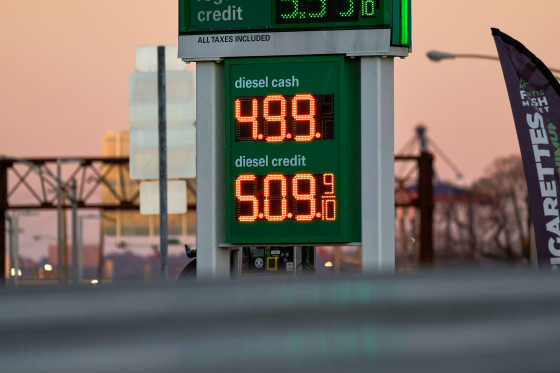
It’s not just retail gasoline. The diesel fuel used to power trucks delivering goods to stores, farm equipment and public transit has risen to $5.45 per gallon, more than $1.80 higher than it was a year ago.

Driving that is the soaring cost of crude oil worldwide. U.S West Texas Intermediate (WTI) crude has risen more than 50% since the war began Feb. 28, while Brent, the international benchmark, has seen a jump of nearly 60%.

On Monday, U.S. crude oil settled above $100 per barrel for the first time since Russia’s full-scale invasion of Ukraine in 2022. Brent crude oil is poised to see its largest one-month increase on record.

Oil prices had already started rising before the Iran war began, fueled by fears that a conflict was imminent. Since the start of the year, the cost of U.S. crude oil is up more than 80% and Brent has skyrocketed almost 90%.

In response to strikes by the U.S. and Israel, Iran has effectively blocked shipping through the Strait of Hormuz, a critical channel off its southern coast. Tehran has also attacked its Gulf Arab neighbors, who are major oil producers.

Typically, more than 20% of the world’s oil supply moves through the waterway. But Iran has repeatedly threatened to attack ships if they move through the strait without permission or if they’re associated with the U.S. or Israel. Several tankers have been hit.

As a result, many tankers are stranded in the Persian Gulf, unable to deliver their products to markets.

Some tankers have been allowed to pass through the strait, including one associated with India and three associated with China. But overall traffic through the waterway is down more than 90% in March.

During the first 28 days of the war, a total of only 55 to 60 tankers have cleared the Strait of Hormuz, according to the ship tracking website TankerTrackers.

Before the war, more than 100 ships per day made the passage, it said.

“This rise in gasoline spending could potentially dampen consumers’ ability to spend on ‘nice-to-have’ or discretionary categories,” Bank of America economists recently wrote.

This year, the average U.S. household will spend an additional $740 on gas because of the jump in oil prices, according to economists from the Stanford Institute for Economic Policy Research.

“The consumer has already seen the sticker shock from rising gasoline prices and increased airline ticket prices from the rising cost of jet fuel,” longtime industry analyst Andy Lipow said. “However, the full effects of the higher diesel prices has yet to be felt and that will flow through the economy over the next few months.”

As American consumers adjust to higher gas prices, oil dependent nations in Europe and Asia are already facing much more severe energy shocks. Inflation, oil and gas rationing and sharp pullbacks in economic growth estimates are impacting billions of people worldwide.