Ripple Treasury has joined the SWIFT Certified Partner Program, which has led to a shift in how corporate treasury systems connect with banking facilities. The integration permits direct access to SWIFT’s network while adding real-time functionality through blockchain-linked tools. The platform, developed through a partnership between Ripple and GTreasury, combines traditional financial operations with digital
As the US-Iran war continues to escalate, Bitcoin is feeling the heat again. Amid rising uncertainty, analysts warn the pioneer cryptocurrency could see massive declines, possibly dropping to a low of $10,000. Ad Ad Analysts Predict Bitcoin Crash to $10K In a critical analysis on CryptoQuant, XWIN Research Japan projected a massive 80% fall in
Strategy (formerly MicroStrategy) could resume its aggressive Bitcoin accumulation, with perpetual preferred stock STRC generating sufficient funds in recent trading sessions. MSTR stock price closed 2.40% at $119.83 on Thursday. Ad Ad Strategy Perpetual Preferred Stock STRC Signals Over 1,800 BTC Buy Strategy’s Stretch perpetual preferred stock (STRC) is estimated to have raised enough money
David Schwartz, CTO Emeritus at Ripple, highlighted three advantages that XRP holds over stablecoins. He put forward the comments while explaining how both assets serve different roles in financial systems. At the same time, he pointed out that XRP is not in competition with stablecoins. However, he identified a gap between the two. According to
The U.S. jobs report has come in stronger than expectations, signaling that the labor market may be stabilizing even amid the U.S.-Iran war. Bitcoin dropped following the data release as traders cut their bets on Fed rate cuts this year. Ad Ad U.S. Jobs Report Comes In Strong, Bitcoin Falls The latest Bureau of Labor
Stocks surged Tuesday, with the S&P 500 closing up 2.9% while the Nasdaq rose 3.8% and the Dow gained 1,125 points.
Subscribe to read this story ad-free
Get unlimited access to ad-free articles and exclusive content.
But this very good day capped off what was a very bad month for U.S. equities. The S&P 500 fell 5.09% in March, and the Nasdaq Composite declined 4.75%.
The U.S.-Israeli war on Iran and the near-total blockade of the Strait of Hormuz, a narrow, Iranian controlled waterway through which a fifth of the world’s crude oil typically transits every day, weighed heavily on markets throughout the month.
Tuesday was also the end of the first quarter of the year, one when the S&P 500 and Nasdaq posted their worst annual starts since 2022, when the Russian invasion of Ukraine rocked markets.
For the first quarter, the S&P 500 dropped 4.6% and the Nasdaq declined 7.1%.
Oil prices, meanwhile, soared over the past month, driving up the cost of fuel and triggering a domino effect of higher prices around the globe.
Brent, the international oil benchmark, posted its largest monthly percentage increase ever, after having risen more than 60%. The price of U.S. West Texas Intermediate crude oil also soared in March, climbing more than 50% in its biggest one-month gain since 2020.
For millions of drivers in the U.S., the increases manifest as higher prices for gas. And here, too, the past month was remarkable. The average price of unleaded gasoline hit $4 per gallon Tuesday, up more than 34% in just four weeks.
But it’s not just gas prices that hit U.S. households this month.
More than half of all adults in the U.S. own stocks, often via their retirement accounts and the broader funds those managed accounts invest in. Most of the time, market moves up and down don’t swing the value of those kinds of diversified retirement accounts.
But March was a different story.
“Stocks have been following the lead of oil prices at an unprecedented rate over the last several weeks, and if the U.S. just walked away from the Middle East with the Strait still blockaded, energy markets would likely remain incredibly supply-constrained, keeping prices high,” analysts at Bespoke Investment Group wrote Tuesday.
“The longer prices are high and supplies are limited, the worse it’s going to be for the global economy and ultimately stock prices,” they added.
The wild market swings of the second Trump administration are in sharp contrast to how Donald Trump said the markets would react if he were elected to a second term in 2024.
“There are many people that are saying that the only reason the Stock Market is high is because I am leading in all of the Polls, and if I don’t win, we will have a CRASH of similar proportions to 1929,” Trump wrote on Truth Social in May 2024 as he campaigned for the presidency.
Shortly after he was re-elected in 2024, Trump was asked whether he believed market indexes were good barometers of his performance in office. “To me … all of it together, it’s very important,” he told CNBC.
But during the first 14 months of his second term, U.S. markets have faced some of the sharpest drawdowns in history.
In February and March of last year, Trump’s sweeping tariff policies roiled the market, pushing the S&P 500 into its seventh-fastest correction of all time. A correction is when a stock or an index declines 10% from its most recent record high.
Just over a year later, the S&P 500 isn’t far from doing it again. As of Tuesday’s closing bell, the index had tumbled 6.7% from its most recent high in January.
As oil prices rise, stocks typically fall given that higher oil prices typically lead to higher prices across a number of industry sectors over the long run.
Already, inflation is on the rise around the world. On Tuesday morning, eurozone inflation came in at 2.5%, from 1.9% the month before, according to the European Central Bank.
On Tuesday, the Nikkei 225 in Japan recorded its worst month since 2008. In Europe, the Stoxx 600 index posted its worst month since 2022.
Two near-corrections in just over a year illustrates just how volatile the administration’s policies have been for markets.
Still, since Trump took office for a second time, the S&P 500 is up 8%, although last year global stocks far outpaced the broad U.S. index.
In 2025, global stocks as measured by the MSCI ACWI ex USA index rose nearly 30%, while U.S. stocks rose just 16%. Global stocks haven’t beaten American equities by that much during the first year of a presidential term since 1993, according to data from Bloomberg.
In recent weeks, Trump has repeatedly touted the Dow’s recent 50,000 milestone as a sign that the markets are doing well in his presidency.
“You know, it’s sort of crazy, I hit 50,000 on the Dow,” Trump said at an investment conference in Florida on Friday. “People said that wouldn’t be possible within four years.”
“And then we hit 7,000 on the S&P,” Trump added. “People said that’s even harder than hitting 50,000 on the Dow.”
As of Tuesday, the Dow had plunged more than 3,600 points since it hit 50,000, a drop of nearly 7.5%.
The grandson of the inventor of the Reese’s Peanut Butter Cups, who has publicly criticized The Hershey Company for tinkering with the classic formula in its spinoff products, appears to have gotten some sweet revenge.
Subscribe to read this story ad-free
Get unlimited access to ad-free articles and exclusive content.
The candy company has announced that it will return to using “classic milk and dark chocolate recipes” in all its Reese’s and Hershey’s products by 2027.
“If this is true, the people who deserve the credit are the loyal fans who were alarmed by what Hershey was doing,” Brad Reese told NBC News on Wednesday. “But I am seeing a lot of red flags here. I think what Hershey is trying to do here is change with PR narrative.”
Reese, whose demands that Hershey stop skimping on chocolate went viral in February, said he trusts his taste buds more than he trusts the company that produces iconic candies that bear his family name.
“If something like the Valentine’s Day Reese’s Mini Heart still doesn’t taste like real milk chocolate next year, I’ll know they’re lying,” he said.
Hershey CEO Kirk Tanner made the announcement on Tuesday in an interview with Bloomberg.
“We’re going to make some small investments to really align the portfolio to what the brand stands for,” Tanner said. “That consistency is important across the brand.”
Reese’s Peanut Butter Cups have been made with the same ingredients since 1928 — milk chocolate and peanut butter.
Starting next year, Tanner said candies inspired by the originals — like the “mini Reese’s cups and shapes,” as well as the Reese’s Fast Break candy bar — will also be made with real milk chocolate instead of a chocolate compound coating.
In addition, all the classic Hershey’s chocolate bars will also be made with “pure milk and dark chocolate,” he said. And Hershey is “enhancing” the Kit Kat candy bar “for a creamier taste and texture.”
In all, the company said the shift from chocolate compound coatings to the real thing will affect less than 3% of the Reese’s products and a tiny portion of Hershey’s products.
And Hershey is “on track” to remove all artificial colors from its products by the end of next year, the company said.
Tanner, in the Bloomberg interview, also insisted that the switch back to real chocolate was in the works long before Reese went public with his complaints.
“Right when I started with the company, we did a deep dive across our portfolio,” said Tanner, who joined the firm in August 2025.
Reese scoffed at that claim from Tanner.
“You know when this became an issue?” he asked. “Valentine’s Day. This has been going on since Valentine’s Day.”
Reese began taking Hershey to task after discovering that the company had replaced the milk chocolate with a chocolate-flavored coating on some of its Reese’s-inspired products, like the Valentine’s Day Reese’s Mini Hearts.
Infuriated, Reese posted a link to a letter of complaint he wrote to Todd Scott, who does the corporate branding for Hershey, on his LinkedIn page.
Reese invoked the name of his grandfather H.B. Reese, who created the iconic peanut butter cup in 1928 and started a candy company that produced them until 1963. Hershey has been making them ever since.
“My grandfather,” Reese wrote, “built REESE’S on a simple, enduring architecture: Milk Chocolate + Peanut Butter.”
But Hershey, he wrote, has replaced the original formula “with compound coatings and Peanut Butter with peanut-butter style cremes across multiple REESE’S products.”
That letter went viral.
Hershey insisted that the Reese’s Peanut Butter Cups were made the same way they had always been. But the company also conceded that, as it expanded its “Reese’s product line,” it had tinkered with the original recipe.
Right now, the Reese’s Mini Eggs that are a staple at Easter celebrations do not contain milk chocolate, according to their labels.
Neither do Reese’s Pieces, which were introduced in 1978 and became a sensation after they were featured in the 1982 movie “E.T. the Extra-Terrestrial.”
In response to an NBC News request for a full list of Reese’s and Hershey’s products that will return to using “classic milk and dark chocolate recipes,” the company released a statement that reiterated much of what Tanner said earlier.
“The core recipes for our Hershey’s chocolate bars and Reese’s peanut butter cups have not changed,” it said in part.
WASHINGTON — House and Senate Republican leaders jointly announced a plan Wednesday that they said would end the shutdown of the Department of Homeland Security that caused major airport delays.
Subscribe to read this story ad-free
Get unlimited access to ad-free articles and exclusive content.
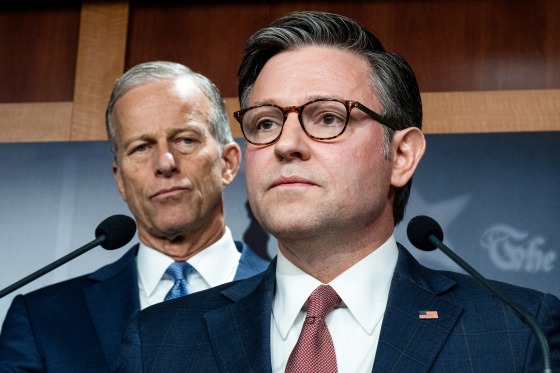
“In the coming days, Republicans in the Senate and House will be following through on the President’s directive by fully funding the entire Department of Homeland Security on two parallel tracks: through the appropriations process and through the reconciliation process,” House Speaker Mike Johnson, R-La., and Senate Majority Leader John Thune, R-S.D., said in a statement.
The two leaders were vague about the exact plan, but it appears to closely resemble the Senate’s preferred path from Friday.
Johnson and Thune heavily implied that it would be for the Senate to, once again, pass a bill it approved unanimously last week, which it could try to do as early as Thursday.
It would fund all of DHS except ICE and Customs and Border Protection, which Democrats won’t agree to fund without reforms to immigration enforcement operations. Those two agencies already have separate funding.
House Republican leaders trashed that bill and rejected it Friday, but they now appear ready to back down and accept the Senate plan. They would have to vote to pass it through the House.
GOP leadership had no immediate comment on the timing for a vote. Both chambers are scheduled to be on recess until April 13.
Then Republicans would fund ICE and CBP in a separate party-line “budget reconciliation” bill that could bypass a filibuster and get approved without any Democratic votes. The timing for that is even less clear.
Johnson and Thune said the “two-track” plan would “fully reopen the Department, make sure all federal workers are paid, and specifically fund immigration enforcement and border security for the next three years so that those law-enforcement activities can continue uninhibited.”
A White House official told NBC News that the administration supports the Johnson-Thune plan.
Earlier Wednesday, President Donald Trump called on Republicans to pass the party-line bill “no later than June 1st.” He threw the earlier plans to reopen DHS into chaos last week when he declined to comment on the Senate bill, which led House Republicans to reject it.
DHS has been shut down for more than a month, with employees for the TSA, FEMA and other agencies going for weeks without pay. Trump signed an executive order last week to pay TSA employees, but the legality and length of that plan are murky. Thousands of civilian Coast Guard employees and other DHS workers are still not being paid.
Senate Minority Leader Chuck Schumer, D-N.Y., slammed Republicans for having “derailed a bipartisan agreement” for days, “making American families pay the price for their dysfunction.”
“Throughout this fight, Senate Democrats never wavered. We were clear from the start: fund critical security, protect Americans, and no blank check for reckless ICE and Border Patrol enforcement,” he said Wednesday. “We were united, held the line, and refused to let Republican chaos win.”
On Friday, House Minority Leader Hakeem Jeffries, D-N.Y., said, “House Democrats are prepared to support the bill to end the Trump-Republican shutdown of the Department of Homeland Security, make sure TSA agents are paid, stand up for FEMA and for the Coast Guard, for our cyber security professionals, and stop inconveniencing Americans.”