The Morgan Stanley Bitcoin ETF (MSBT) will boast the lowest fees among the BTC ETFs, except Van Eck’s fund, which has a fee waiver, when it launches. Bloomberg analyst Eric Balchunas described the low fees as a smart move as the bank looks to rival BlackRock’s IBIT, which is the largest Bitcoin ETFs. Morgan Stanley
Cardano founder Charles Hoskinson criticized Ripple CEO Brad Garlinghouse during a a weekly crypto rollup video over support of the CLARITY Act, arguing the proposal could reshape crypto regulation. He accused Garlinghouse of backing a framework that could classify most projects as securities. Charles Hoskinson CLARITY Act Criticism In a weekly rollup youtube video, Charles
Sam Altman’s World completed $65 million in WLD token sales through OTC deals over the past week, according to The World Foundation. The World transactions involved four counterparties, with the first settlement recorded on March 20, 2026. The sales funded operations, research, and infrastructure, executed through World Assets, Ltd. at an average price of $0.2719.
Crypto-backed credit lines, like fixed loans, are an opportunity for crypto investors to obtain capital from lending services without selling their assets. In both cases, investors commit their crypto assets to a lending platform or product as collateral and receive another crypto asset (usually stablecoins) or fiat currencies. But crypto-backed credit lines offer increased flexibility
Ethereum Price remains under pressure as investors assess the possibility of a move toward $4,000 by the end of 2026. The Ether recently slipped below $2,100 amid rising geopolitical tensions. Broader crypto market weakness has limited recovery attempts. Nonetheless, a number of long-term drivers remain in favor of a possible rebound should market conditions improve.
A federal judge in California has blocked the Trump administration from designating Anthropic as a supply chain risk to national security and cutting off the AI company’s work with federal agencies.
Anthropic sued the Defense Department and other federal agencies this month after the Pentagon labeled it a “supply-chain risk to national security.” President Donald Trump said he would also ban the use of Anthropic’s products across other federal agencies.
“Defendants’ designation of Anthropic as a ‘supply chain risk’ is likely both contrary to law and arbitrary and capricious,” U.S. District Judge Rita Lin of Northern California wrote in her order Thursday night. “The Department of War provides no legitimate basis to infer from Anthropic’s forthright insistence on usage restrictions that it might become a saboteur.”
Lin paused her order for a week to allow the administration time to appeal.
The Defense Department and the White House did not immediately respond to a request for comment Thursday evening.
“We’re grateful to the court for moving swiftly, and pleased they agree Anthropic is likely to succeed on the merits,” an Anthropic spokesperson said in a statement Thursday. “While this case was necessary to protect Anthropic, our customers, and our partners, our focus remains on working productively with the government to ensure all Americans benefit from safe, reliable AI.”
The supply chain risk designation requires the Pentagon and its contractors to stop using Anthropic’s commercial AI services for all defense business.
Defense Secretary Pete Hegseth said on X in late February that he was issuing a directive to give the company the “supply chain risk” label. Trump also said he was ordering all federal agencies, including the Treasury and State departments, to cease using Anthropic’s AI technology.
“The record reflects that the Challenged Actions were taken without any meaningful notice or pre-deprivation process (and, in the case of the Presidential Directive and the Hegseth Directive, without any post-deprivation process either),” Lin wrote in her order.
The order Thursday also bars other agencies from cutting off their work with Anthropic. Lin wrote that the order restores the status quo.
“This Order does not require the Department of War to use Anthropic’s products or services and does not prevent the Department of War from transitioning to other artificial intelligence providers, so long as those actions are consistent with applicable regulations, statutes, and constitutional provisions,” the order said.
Anthropic filed two lawsuits against the Defense Department — one in U.S. District Court for Northern California and the other in U.S. Circuit Court of Appeals for Washington, D.C. — alleging that the federal government’s moves go beyond a normal contract dispute and instead are an “unlawful campaign of retaliation” that followed months of heated negotiations about how the military should be able to use Anthropic’s AI systems.
Anthropic had sought stronger guarantees that the Pentagon would not use its AI systems for autonomous weapons or mass domestic surveillance.
Anthropic is the creator of the Claude chatbot system and the only AI company whose services were cleared for use on the Defense Department’s classified networks.
Hours after Hegseth’s announcement last month, OpenAI CEO Sam Altman said his company had reached an agreement with the Pentagon to use its services in classified settings.
Lin wrote: “Although Anthropic was on notice that the government objected to its contracting terms, it had no notice or opportunity to object before Defendants publicly barred it from all federal government work and blacklisted it with private companies working with the U.S. military. It also had no notice or opportunity to object to the factual basis for its designation as a supply chain risk, which it learned of in this litigation.”
WASHINGTON — The Senate agreed unanimously early Friday to fund the Department of Homeland Security, but without funding for immigration enforcement and deportation operations.
Senators approved the package at 2:20 a.m. by voice vote following a marathon session.
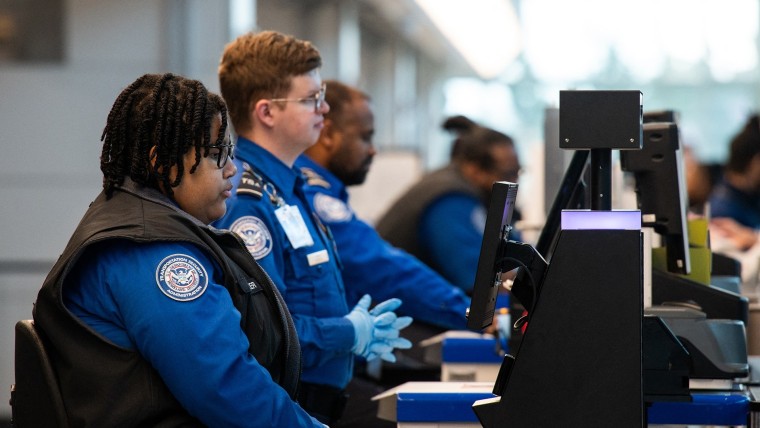
The 42-day funding lapse has seen them go without pay, leading many to call out of work and causing long lines at airports. While the measure still needs to pass the House, the Senate vote paves the way to allow airports to fully function again.
The legislation would fund all of DHS except Immigration and Customs Enforcement and Customs and Border Protection, which Democrats have refused to vote for without significant reforms to immigration raids and deportation practices.
The deal followed arduous bipartisan negotiations that occurred in fits and starts over the last six weeks, succumbing to the impasse around policy changes to immigration enforcement. Under the new plan, Democrats get their weeks-long demand to fund the department with the exceptions of ICE or CBP, but also without the restrictions they sought on how immigration officers may conduct operations.
“This could have been done three weeks ago,” Senate Minority Leader Chuck Schumer, D-N.Y., said. “This is exactly what we wanted.”
Long wait lines at a TSA checkpoint at New York’s LaGuardia airport Friday.Gabrielle Korein / NBC News
The bill faces an uncertain future in the Republican-controlled House. It is expected to have President Donald Trump’s support, which could help corral conservatives who have been skeptical about splitting off ICE funding from the underlying bill.
“Hopefully they’ll be around, and we can get at least a lot of the government opened up again, and then we’ll go from there,” Senate Majority Leader John Thune, R-S.D., said of the House and a potential vote on Friday. He said he texted with Speaker Mike Johnson, R-La., on Thursday night.
The Senate adjourned for a two-week recess, leaving the House with few options other than to accept their bill as written.
Thune separately blamed Democrats. “President Trump should never have had to step in to rescue TSA workers and U.S. air travel. We are here because, thanks to Democrats’ determined refusal to reach an agreement, there will be no Homeland Security funding bill this year.”
Speaking after the vote, Schumer said: “In the wake of the murders of Renee Good and Alex Pretti, Senate Democrats were clear. No blank check for a lawless ICE and Border Patrol.”
He added that the “long overdue agreement” funds TSA, the Coast Guard, the Federal Emergency Management Agency and the Cybersecurity and Infrastructure Security Agency, and “strengthens security at the border and the ports of entry, and keeps Americans safe.”
He added that the deal “could have been accomplished weeks ago if Republicans hadn’t stood in the way.”
The White House and Republicans declined to grant Democrats’ demands to restrict Trump’s immigration practices. They now plan to pursue the remainder for funding for ICE and CBP in a separate party-line bill, which they could also use to pass Iran war funding and elements of the Trump-backed SAVE America Act.
Senate Republicans held a vote open for hours Thursday as the two sides continued to negotiate, having traded offers for days.
Trump, meanwhile, announced earlier Thursday that he would instruct newly sworn-in Homeland Security Secretary Markwayne Mullin to “immediately pay our TSA Agents in order to address this Emergency Situation.”
That move may not be needed if the House passes the Senate legislation, according to a senior administration official, who said the White House is waiting to see what will happen.
This official also said the funds to pay TSA agents would come from the so-called One Big Beautiful Bill, the tax-cut and spending legislation Trump signed into law in July. It’s not clear exactly how that would work, but the administration has dipped into those unspent funds before to cover pay gaps during funding lapses.
The House can either debate and vote out the Senate-passed measures in the Rules Committee before bringing them to the floor under a simple majority vote, or Johnson can seek to fast-track it to the floor.
The House was set to hold an unrelated vote at 10 a.m. before leaving for recess.
We’d like to hear from you about how you’re experiencing the partial government shutdown, whether you’re a TSA agent who can’t work right now or a federal employee who is feeling the effects at your agency. Please contact us at tips@nbcuni.com or reach out to us here.
TSA officers missed their first full paychecks in mid-March, leading many to call out of work. Call-out rates for TSA officers have exceeded 11% nationally, with rates at some airports passing 40%.
Trump sent ICE agents to airports to help TSA earlier this week. Unlike TSA officers, ICE agents continue to receive paychecks during the partial shutdown as a result of funding from the so-called One Big Beautiful Bill, a sweeping GOP domestic policy package, that Trump signed into law last year.